Port information

Plan a safe and efficient call at the Port of Elsinore. Find quay specifications, navigation guidance, port rules, prices and practical services in one place.

Information for cruise ships

For information specifically for cruise ships, please go to the cruise page.

Important information

Entry must be arranged with the port officer in advance. Current wind, current and wave conditions determine the largest vessel that can safely enter.

150 × 30 m

Maximum vessel in favourable conditions

7.3-7.5 m

Access channel depth; 7.3 m near the Northern Mole

3 / 6 knots

3 knots in basins; up to 6 knots on entry and exit

VHF 12 / 16

Mandatory monitoring in port

+45 49 21 05 15

Call the port officer 30 minutes before arrival

Quay facilities

Technical quay specifications, harbour map and pictures of the quays.

Pilotage & navigation

The Øresund TSS, VTS Sound, Inshore Traffic zone and navigational rules.

ISPS, TallyWeb & access

Security, payment for private vessels, accessibility and parking in port areas.

Dues, taxes & services

Port dues, taxes on goods, rental of land, services, prices, terms and regulations.

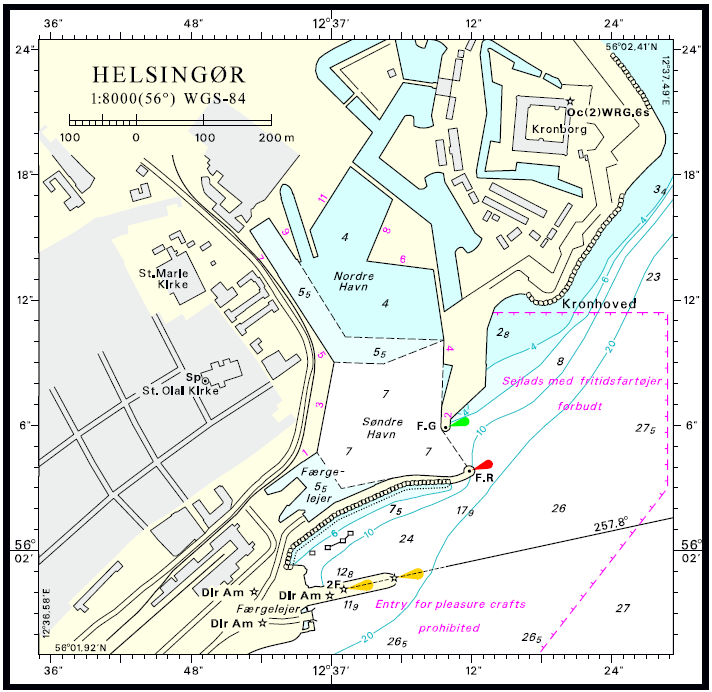
Explore Helsingør Harbour. Choose a quay for specifications, or preview a quay using its marker.

This map is informational and does not replace a nautical chart. Specifications follow the supplied quay-information document; chart markings may differ. Sewage vacuum entries describe access for a vacuum tanker. Confirm source warnings with Helsingør Harbour before use.

Open full-resolution map (new tab)

Selected quay

Quay 3 – Kongekajen (Royal Quay)

Length
135.5 m
Maximum LOA
150 m
Depth
7 m
Width or quay type
18.5 m to crane foundation; 23.5 m to railway.
Height
2.1 m
Electricity
Normally 125 A; may be increased to 163 A with an electrician arranged beforehand.
Fresh water
Yes; source states “30 m\3 per hour”.
Sewage vacuum
Yes
Bollard SWL
20 t

Source confirmation required. Fresh-water unit “m\3” needs confirmation. The annotated PNG states 143 m length and 163 A without the document’s electrical qualification; the document governs this panel.

All quay specifications

Quay 3 – Kongekajen (Royal Quay)

Length
135.5 m
Maximum LOA
150 m
Depth
7 m
Width or quay type
18.5 m to crane foundation; 23.5 m to railway.
Height
2.1 m
Electricity
Normally 125 A; may be increased to 163 A with an electrician arranged beforehand.
Fresh water
Yes; source states “30 m\3 per hour”.
Sewage vacuum
Yes
Bollard SWL
20 t

Source confirmation required. Fresh-water unit “m\3” needs confirmation. The annotated PNG states 143 m length and 163 A without the document’s electrical qualification; the document governs this panel.

Breakwater – Tender Pier – Jetty

Length
90 m
Maximum LOA
90 m
Depth
4 m
Width or quay type
4 m
Height
0.75 m
Electricity
32 A
Fresh water
Yes, via garden hose.
Sewage vacuum
Yes, as far as 40 m along the pier.
Bollard SWL
5 t

Source confirmation required. The annotated PNG gives 150 A and no water or sewage service; this panel follows the quay-information document.

Quay 2

Length
55 m
Maximum LOA
55 m
Depth
7 m
Width or quay type
10 m
Height
1.95 m
Electricity
125 A
Fresh water
Yes, via garden hose.
Sewage vacuum
Yes
Bollard SWL
Not specified

Source confirmation required. Bollard SWL is not specified. The annotated PNG states “Under construction”, 163 A and 30 m\3/hour water. Construction status is not confirmed by the document; its specifications govern this panel.

Quay 4

The quay has a small bend; north and south sections are distinguished in the source.

Length
Total: 69.5 m; North: 42.5 m; South: 27 m.
Maximum LOA
69.5 m
Depth
7 m
Width or quay type
10 m
Height
1.9 m
Electricity
63 A
Fresh water
Yes, via garden hose.
Sewage vacuum
Yes
Bollard SWL
Not specified

Source confirmation required. Bollard SWL is not specified. The annotated PNG gives 4 m depth, 163 A and 30 m\3/hour water; this panel follows the document.

Quay 5

Divided into north and south sections by the breakwater.

Length
Source total: 149 m; North: 97 m; South: 44 m.
Maximum LOA
North: 97 m; South: 60 m.
Depth
5.5 m
Width or quay type
5.5 m
Height
2.1 m
Electricity
63 A
Fresh water
North: yes, source states “30m\3 per hour”; South: yes, via garden hose.
Sewage vacuum
Yes
Bollard SWL
20 t

Source confirmation required. The stated sections total 141 m, not the stated 149 m. Fresh-water unit “m\3” needs confirmation. The exact wooden-deck boundary with Quay 7 is not identified on the chart. The annotated PNG states 163 A; the document states 63 A.

Quay 6 – Græskaj / Ravelin

Length
100 m
Maximum LOA
100 m
Depth
4 m
Width or quay type
Grass quay
Height
1.7 m
Electricity
63 A
Fresh water
Yes, from festival service well via garden hose.
Sewage vacuum
No
Bollard SWL
Not specified

Source confirmation required. Bollard SWL is not specified. The annotated PNG gives 150 A and no water; this panel follows the document.

Quay 7

Quays 5 and 7 meet at the wooden deck.

Length
72 m
Maximum LOA
72 m
Depth
4 m
Width or quay type
4 m on the wooden deck.
Height
1.35 m
Electricity
63 A
Fresh water
Yes, via garden hose. Quay 7 South has a water cabinet that is frost-free all year.
Sewage vacuum
Yes
Bollard SWL
Not specified

Source confirmation required. Bollard SWL is not specified. The exact wooden-deck boundary is not identified on the chart. The annotated PNG gives 5.5 m depth, 150 A and 30 m\3/hour water; this panel follows the document.

Quay 8 – Græskaj / Ravelin

Length
100 m
Maximum LOA
100 m
Depth
4 m
Width or quay type
Grass quay
Height
1.7 m
Electricity
63 A
Fresh water
Yes, from festival service well via garden hose.
Sewage vacuum
No
Bollard SWL
Not specified

Source confirmation required. Bollard SWL is not specified. The annotated PNG gives 150 A and no water; this panel follows the document.

Quay 9

Length
63 m
Maximum LOA
Not specified
Depth
5.5 m
Width or quay type
8 m
Height
2.0 m
Electricity
16 A
Fresh water
Yes, via garden hose.
Sewage vacuum
Yes
Bollard SWL
Not specified

Source confirmation required. Maximum LOA and bollard SWL are not specified.

Dokken

Reserved for historical vessels only.

Length
123 m
Maximum LOA
Not specified
Depth
4 m
Width or quay type
10 m
Height
1.4 m / 1.7 m (source does not identify the locations).
Electricity
32 A
Fresh water
Yes, via garden hose.
Sewage vacuum
Yes
Bollard SWL
Not specified

Source confirmation required. Maximum LOA and bollard SWL are not specified. The two heights are not assigned to locations. The traced dock-shaped inlet is not named on the chart; confirmation that it is Dokken is required.

Quay 11 – Floating pontoons 1–4

Four individual floating pontoons. The document supplies identical specifications for pontoons 1, 2, 3 and 4.

Length
27 m per pontoon
Maximum LOA
Not specified
Depth
4 m per pontoon
Width or quay type
3.0 m per pontoon
Height
0.6 m per pontoon
Electricity
32 A per pontoon
Fresh water
Yes, via garden hose, at each pontoon.
Sewage vacuum
Yes, at each pontoon.
Bollard SWL
Not specified

Source confirmation required. Maximum LOA and bollard SWL are not specified for any of the four pontoons. The chart does not assign individual pontoon numbers; all four are highlighted together.

Pilotage, TSS & port rules

The sea immediately outside the Port of Helsingør is the Øresund Sound. It is about 4 km wide at its narrowest point and carries heavy ferry and commercial traffic.

Pilotage is not compulsory when calling the Port of Helsingor. Pilotage can be an extra security for larger vessels calling Helsingør for the first time. For pilot services in Denmark, we refer to the Pilotage Service Providers (PSP) that are registered in the Danish Maritime Authority’s register of PSPs. These can be found on the Danish Maritime Authority’s website.

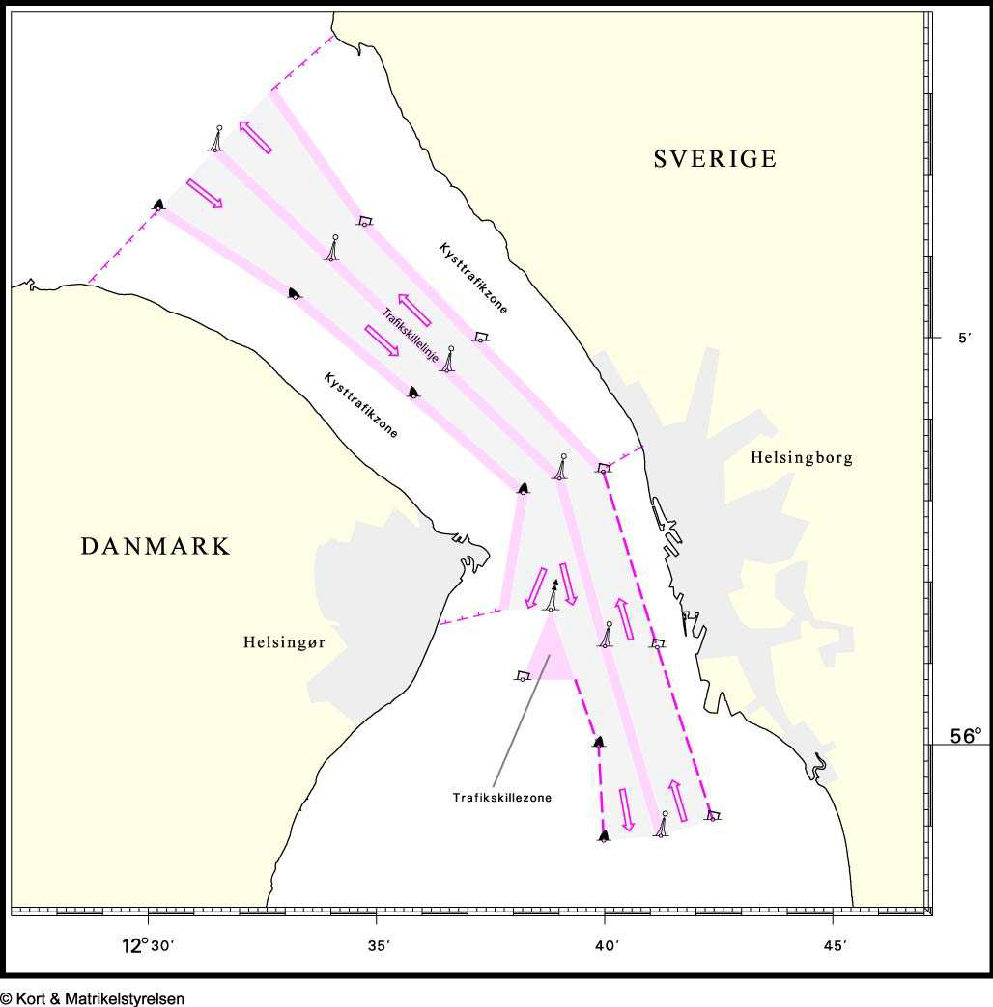
The sea just outside of the Port of Helsingør is called the Øresund Sound. The sound is very narrow and about 4km at the narrowest point. In the north of the strait between Helsingør and Helsingborg there is a TSS (Traffic Separation System).

Every year, approx. 35,000 ships pass through the Sound. Many of these ships are large cargo or passenger ships. In order to avoid dangerous situations with large ships, seven traffic separation systems have been established in Danish waters where it is important to sail correctly in accordance with the provisions for preventing collisions at sea. Two of these TSS have are in the North and South of the Sound.

You can find more information about the TSS and navigating the sound at the official website of the Danish Maritime Authority and in the Danish Maritime Authority’s “Sail safely and legally in the Sound and in other places with traffic separation systems” (in Danish).

Currents and countercurrents

VTS Sound is a joint Danish–Swedish organisation that has assisted ships navigating the Sound since 2007. The port strongly recommends contacting VTS Sound when navigating outside Helsingør: VHF 73 north of Øresund, VHF 71 south of Øresund, telephone +46 771 63 06 00 or contact@soundvts.org.

A northward-flowing current originates from the southern pier head and flows toward the coast west of Kronhoved; from there, it turns eastward around Kronhoved and then northeastward past Kronborg Pynt. At the same time, as it strikes the coast at Kronborg, it creates a countercurrent (a backwater) that flows westward along the coast and then turns southward toward the harbor entrance.

Current conditions

Due to the current conditions, special expertise is required to enter or leave the harbor under adverse conditions. This applies particularly to vessels with low engine power. Note that the current can exceed 3 knots, but is usually around 3 knots.

For any inquiries about the sailing to and from the port of Helsingør we refer to the Danish Maritime Authority. You can contact them in one of the ways below:

Danish Maritime Authority

General enquiries and maritime / personal accidents:

+45 72 19 60 00
sfs@dma.dk

Office hours

Monday – Thursday: 09.00 – 16.00

Friday: 09.00 – 15.00

Maritime Regulation and Legal Affairs

+45 72 19 60 00

Navigation contacts

Contact the port officer for movements in the port. For general enquiries about sailing to and from Helsingør, contact the Danish Maritime Authority.

Port VHFChannels 12 and 16
Danish Maritime Authority+45 72 19 60 00 · sfs@dma.dk

Since the sound is in between the two countries of Denmark and Sweden, a joint organization called VTS Sound has since 2007 helped all ships navigating through the sound. VTS Sound is a free service for all ships sailing through Øresund and at the port we strongly recommend being in contact with them on VHF 73 whenever you navigate the seas outside of Helsingør.

For any inquiries about navigating the sound, please contact VTS Sound at one of the below options:

Contact

Area / detail

VHF 73

North of Øresund

VHF 71

South of Øresund

+46 771 63 06 00

VTS Sound telephone

contact@soundvts.org

VTS Sound email

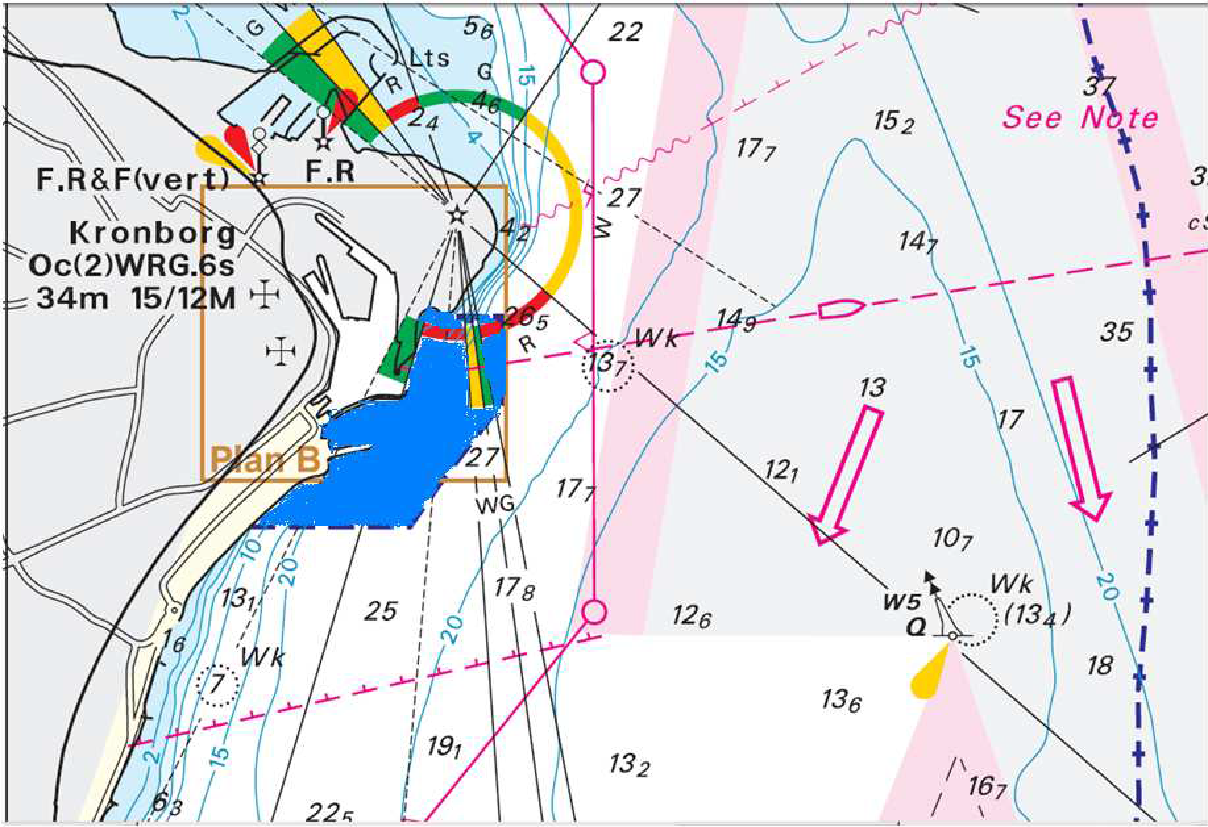
Off the coast of the Port of Helsingør, a restricted area has been established due to heavy ferry traffic. This area is called an inshore traffic zone (ITZ). Within this area, all unauthorized diving and navigation by recreational vessels is prohibited. Exempt from this prohibition are recreational vessels over 15 meters in length that have received permission from the port to call at the port, as well as diving conducted with the port’s permission. You can see the ITZ clearly marked with a pink line on the image below. For ships anchoring outside of the Port of Helsingor it is very important that you stay outside of the ITZ.

Anchorage requirement

Ships anchoring outside the Port of Helsingør must stay outside the ITZ.

1. No entry without prior arrangement with the port officer

2. Always call the port officer 30 minutes before arrival. Phone number: +45 49 21 05 15

3. It is mandatory to monitor VHF channels 12 and 16

4. Give way to ferries

5. Outbound vessels must yield to inbound vessels

6. Call the port officer in case of emergency

Depths and vessel dimensions

The depth in the access channel is 7.5 m, though it is only 7.3 m near the head of the Northern Mole. See the map below.

Depth warning

Due to current conditions and heavy traffic from vessels with high engine power, whose propeller wash can cause ripples, the stated depths cannot always be relied upon to be present in the entrance channel or throughout the harbour basins.

The largest ships that can enter the harbor depend on the current wind, current, and wave conditions. Under favorable conditions, the largest ship that can enter the harbor is: 150 m long and 30 m wide.

The port can normally be navigated both day and night. Particular attention should be paid to current conditions.

Northbound and southbound current risks

When the current is flowing northward, the bow may be affected by the tidal current, while the northward current continues to act on the stern of the vessel, which is then at risk of striking the inner side of the South Pier with its bow. With a southbound current, great caution must be exercised when passing the southern pier head to avoid heading toward the northern pier head. The vessel should therefore always maintain sufficient speed to keep it under control until it has fully entered the breakwater.

Reporting and speed

All vessels must report their arrival, departure, or maneuvering to the harbor master’s office 15 minutes in advance by calling +45 49 21 05 15 or via VHF channel 12/16.

The maximum permitted speed throughout the harbor basins is 3 knots. However, during entry and exit, the speed limit is up to 6 knots.

On/off ISPS arrangements

At the Port of Helsingør, we use an on/off facility for ISPS. We put up the necessary barriers to create an ISPS zone whenever it is needed, and we take them down when it is not. An ISPS area will always be established for passenger vessels. ISPS is always included in the port dues.

TallyWeb

TallyWeb – For paying port dues and electricity for private ships and boats above 15 m / 50 ft

TallyWeb is an automated service to pay your port dues and electricity at the port without having to contact the port officer in advance. This service is, however, only intended for private ships and boats above 15m / 50t length. If you are a company doing business in the port, please contact the port personnel directly. If you boat is shorter than 15m / 50ft please use the Helsingør Marina (Helsingør Nordhavn).

TallyWeb works by going to the stand closest to where your ship is docked, scanning the QR code and following the instructions. The stands are placed in multiple spots around the port. When your registration is confirmed, you are good to go. Through TallyWeb, you can also extend or shorten your stay. If you wish to use electricity during your stay in the Port of Helsingør, you can also do this through the TallyWeb stand. Whenever you register your ship or boat, just choose how many kWh you need and add it to your registration. The balance of your stay will be withdrawn whenever your stay ends.

You can find detailed instructions on the side of the TallyWeb stands around the port. For your convenience, you can find a picture of the instructions below:

Find Tally stand

Go to the nearest tally stand and read the instructions.

Scan QR code

Scan the QR code on the red poster with your mobile phone.

Add details and pay

Press ‘Buy Now’ and follow the instructions.

Get your PIN code

You will receive a PIN code to use during your stay.

Prolonging your stay

Should you wish to extend your stay, you can use the Tally system to do so.

You must purchase your extension before 11 am on the original planned date of departure.
Scan the QR code at the Tally stand again.
Scroll down and choose the amount of extra nights required.

Getting around Helsingør

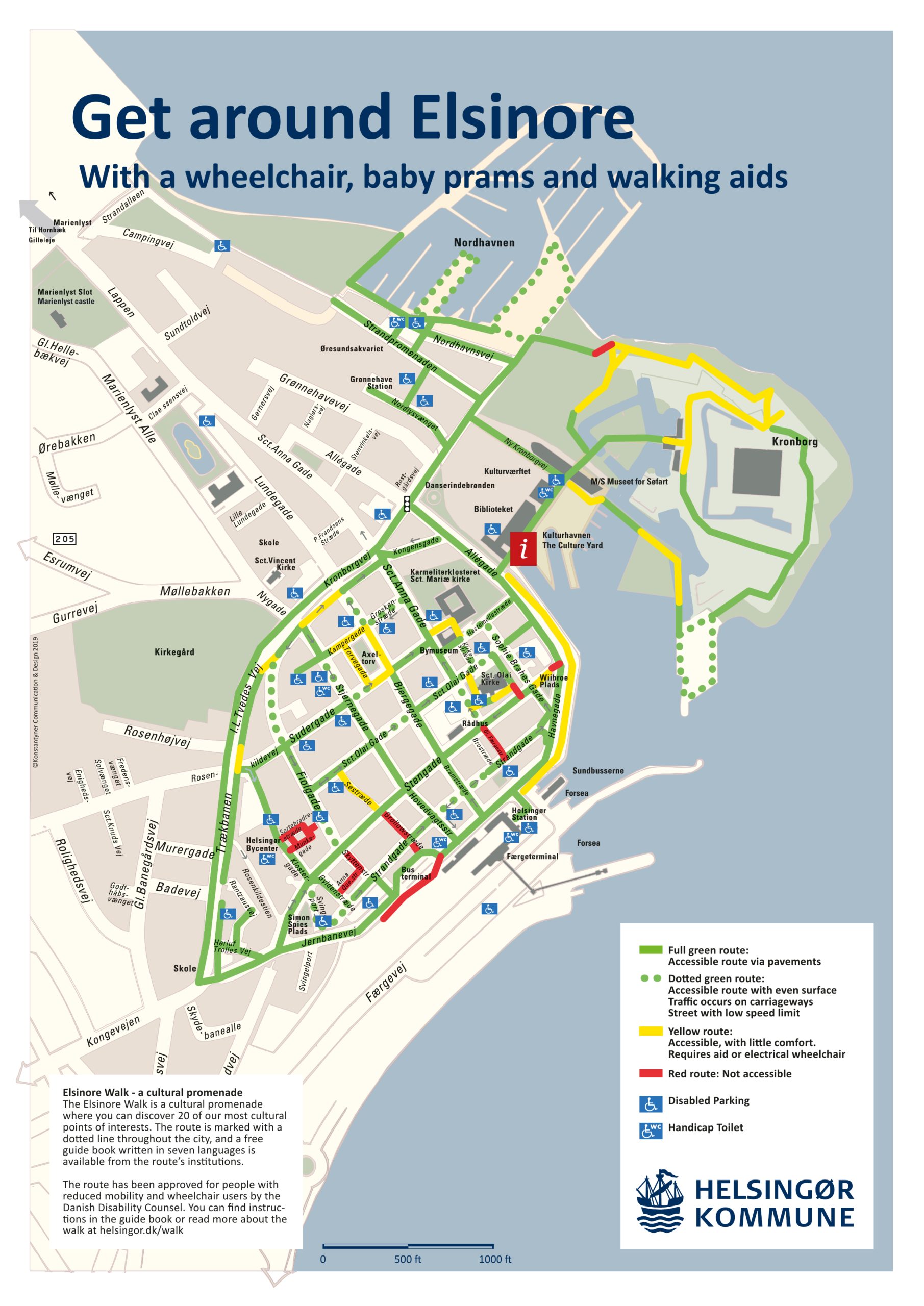
Helsingør is a 500-year-old town that wishes to preserve as much of its history as possible. As with any other old Northern European town, most of the roads and paths are cobblestone. However, the municipality of Helsingør has created stone tracks around most of the town to make it more accessible for wheelchairs, prams and other walking aids. You can find an accessibility map below.

Parking permits

It is not permitted to park in any of the port areas without prior agreement with the port officer or Helsingor municipality. Temporary parking permits can be given in relation to activities during a call or in relation to activities on board or with a ship currently docked in the Port of Helsingør. Please call the port officer at +45 49 21 05 15 to arrange such a permit.

Tour-bus parking

For tour buses visiting Kronborg Castle, M/S Maritime Museum of Denmark or the Culture Yard, a temporary parking for up to four buses has been established by the Municipality of Helsingør. These four spots are on a first come first serve basis. Any bus that is not parked within the four marked spots will be fined a fee equal to the standard parking fine.

Commercial cargo and non-passenger service vessels

Port dues for commercial cargo-carrying vessels and commercial non-passenger service vessels:

Basis

Charge

Single call

4,34 DKK per GT

Monthly fee

24,84 DKK per GT

The monthly fee (B) is paid monthly in advance and grants the right to an unlimited number of calls within the relevant calendar month. The monthly fee cannot be refunded in any case.

If ISPS is required in connection with a call by a commercial cargo-carrying or non-passenger service vessel, the following conditions apply:

ISPS Basis

Charge

Single call

0,12 DKK per GT

Monthly fee

0,45 DKK per GT

A monthly fee may be charged if the vessel settles port fees on a monthly basis. Any extraordinary security measures requested by the vessel or imposed by the authorities will be billed separately based on the time and resources expended.

All prices are indicative and exclusive of VAT

Commercial cargo and non-passenger service vessels

Port dues for cruise ships. Port of Helsingor cruise ship definition is non-cargo carrying commercial passenger vessels exceeding 50 meters in length with a gross tonnage of over 1.000 GT operated by a cruise line.

The Port of Helsingor has chosen to lock the rates until 2029, this means no raise in GT and passenger fees for cruise ships before 2030. This does not count for other services.

There are three different types of fees, depending on the berth option and a passenger fee. All the above port information about anchor/tender is also consistent for Lite Calls. Lite Calls are not available for ships calling alongside.

All prices are indicative and exclusive of VAT.

Fee

Euro

Danish Kroner (DKK)

Per Unit

Cruise Ships calling alongside. Mainly at the Royal Quay

0,50€

3,73 DKK

GT

Cruise Ships calling at anchor and tendering

0,30€

2,24 DKK

GT

Cruise Ships at Lite Calls (please see below for specifications for Lite Calls)

5.350€

39.955 DKK

Call

Full-calls: The highest number of either total arriving passengers or total departing passengers. Incl. the ones who do not disembark the ship. Lite-calls: Only passengers disembarking/embarking. Not passengers who stay on the ship. (ISPS, security, tourist information, maps and port representative at the pier included)

1,50€

Full calls: 11,20 DKK Lite calls: 5,10 DKK

Passenger

15% discount on tonnage fee for three or more calls from the same cruise line brand within one calendar year, including lite calls.

Cancellation – cruise ships only

Time before ETA

Rescheduled (same calendar year)

Full cancellation

3+ months

No fee

No fee

72 hours – 3 months

No fee

50% of total fee

< 72 hours

25% of total fee

100% of total fee

If the ship has to cancel the call due to unforeseen circumstances that are not the fault of the cruise line, cruise ship, or its passengers (E.g., weather, geopolitical situation), special cancellation conditions may apply. Please get in touch with the port if circumstances like this occur.

Commercial fishing vessels and schooners

Port dues for commercial fishing vessels and schooners, including vessels of this type used for safaris and tours.

Vessel category

Rate

Commercial vessels with a contract

339 DKK per m2

Commercial vessels without a contract

420 DKK per m2

Prepaid dues are non-refundable in any case

All prices are indicative and exclusive of VAT

Commercial, chartered and private passenger vessels

Prices per day

For vessels weighing less than 1.000 GT, the following conditions apply.

Length of vessel

Per Day

15 – 20 m

493 DKK

20 – 25 m

612 DKK

25 – 30 m

675 DKK

30 – 35 m

919 DKK

35 – 40 m

1.017 DKK

40 – 45 m

1.386 DKK

45 – 50 m

1.723 DKK

Over 50 m

2.280 DKK

For vessels weighing more than 1.000 GT, the fee will be calculated equally to a cruise ship at 3,73 DKK per GT per day

Port dues in connection with disembarkation or embarkation of passengers from vessels alongside or at anchor are the same no matter the type of call. The passenger fee at the Port of Helsingor is 11,2 DKK per passenger per call. ISPS is always included in the passenger fee if a passenger fee applies to the call.

All prices are indicative and exclusive of VAT

Exemptions from port dues

Vessels belonging to Danish or foreign government authorities, not designed to carry cargo or passengers

Vessels registered for fishing, except in cases where the vessel calls the port to unloads fish that have been loaded in another port

Vessels calling the port solely to seek medical assistance, disembark a sick person, a vessel wrecked, carrying dead bodies or vessels that are forced to seek land due to damage, storm, fog or other weather conditions provided that the call does not extend beyond 24 hours

Vessels member of the Danish Wooden Vessel Association and have a certificate of preservation, if their stay does not exceed 48 hours. This does not apply if passengers are being picked up or disembarked

Vessels participating in regatta to promote Helsingør

When calculating taxes on goods, the rule in this section applies:

Duties on Goods are payable on all goods, except goods used for the Vessel only, which are unloaded or loaded or otherwise set ashore in the port or in the dredged channels leading to it. The Vessel or its agent must pay the duties on the goods to the port before disembarking.

However, the port may against a deposit or other security, grant permission to set sail before the duties have been paid. Duties on goods are payable by the consignee og consignor respectively and the Vessel has recourse against the consignee or consignor, respectively.

Duties on goods are charged per whole unit calculated according to the customs tariff.

All prices are indicative and exclusive of VAT

Goods / customs tariff category

Duty

Ferry, trailer and Container Cargo

26,34 DKK per ton

Oil and Gasoline usage, tariff chapter 27.10

28,86 DKK per ton

Cement, tariff chapter 25.23

12,42 DKK per ton

Coal, tariff chapter 27.01-27.04

15,87 DKK per ton

Stone and gravel, tariff chapter 25 (except 25.01 and 25.23)

7,74 DKK per ton

Grains tariff chapter 10, Oilseeds tariff chapter 12, animal feed tariff chapter 23, salt tariff chapter 25.01, fertilizers tariff chapter 31, wood and wood chips tariff chapter 44.01-44.07 and 44.09, metal waste tariff chapter 72.04

14,14 DKK per ton

Fresh Fish and Shellfish unloaded from fishing vessels or fishing boxes in a processed or unprocessed state, by sales value

3,61%

Other Goods

27,62 DKK per ton

Special cargo, building elements including steel and concrete elements

190,60 DKK per ton

Exemptions from taxes and goods

The following goods are exempt:

Conditions and other necessities for the vessels own use

Ice, salt and chemicals for preserving cargo or expected catch

Seamarks not shipped as a commercial item

Mail and luggage

Goods and equipment for the port’s own use

Goods that are temporarily unloaded but reloaded during the same stay

Land rent is paid for the use of the ports area. The rent will be charged to the tenants of the area.

Rental basis

Rate

Fixed annual rent

26,34 DKK per ton

Temporary rental for events, storage of goods, etc.

10,74 DKK per m2 per commenced week

All prices are indicative and exclusive of VAT

Exemptions from taxes and goods

The following goods are exempt:

Conditions and other necessities for the vessels own use

Ice, salt and chemicals for preserving cargo or expected catch

Seamarks not shipped as a commercial item

Mail and luggage

Goods and equipment for the port’s own use

Goods that are temporarily unloaded but reloaded during the same stay

Electricity

A fixed meter reading fee is paid either per connection or per month. This fee is 50 DKK.

An electricity fee is paid by consumption per KwH from the port’s electrical installations. This fee is equal to the current market price of electricity + 10% on top.

All prices are indicative and exclusive of VAT

Water

Ships that bunker water exclusively from the port’s water hydrants, handles the connection and disconnection of water hoses themselves, and consume less than 3 m³ per call are exempt from the water fee.

The water from the port’s water hydrants is intended exclusively for the vessel’s freshwater tanks. Any failure to comply with the intended use will lead to the port collecting the full fee for water consumed and a fee for any hours needed to fix possible problems.

If assistance from the port is needed in relation to connecting or disconnecting water hydrants, a fee is charged. This fee is 540 DKK per commenced man-hour.

For water consumption higher than 3 m3 a fee is charged. This fee is 26,45 DKK per m3.

All prices are indicative and exclusive of VAT

Manpower and cleaning

For cleaning after loading/unloading of vessels or after rental of the port’s areas, the port charges a cleaning fee based on the number of man-hours and machine-hours used.

The fee per man-hour used is: 540,00 DKK

The fee per machine-hour used is: 540,00 DKK

An environmental tax of 50 DKK is collected for any cleaning tasks done by the port.

All prices are indicative and exclusive of VAT

Manpower and mooring

For mooring at the quays and piers, a mooring fee is charged based on the number of man-hours used. Mooring is not mandatory but recommended. Especially for ships above 50m length and ships calling the Port of Helsingor for the first time. The port recommends a minimum of three men and a minimum of one hour.

The fee per man-hour used is: 540,00 DKK

All prices are indicative and exclusive of VAT

Receiving waste from vessels

Solid waste reception is available at the port, which operates under an approved Port Waste Management Plan (PWMP). The port can receive up to 3 tons (8 m³) of solid waste at no cost.

Facilities for black and grey water disposal are also available. Vessels can connect directly to the municipal system via MARPOL-standard fittings.

For larger quantities of waste, disposal must be handled by a third-party provider at the ship’s request. The port can recommend approved companies for solid waste collection, and for sewage, it’s possible to arrange 1–2 tank trucks (each with a capacity of approximately 35 m³). Prices are agreed directly with the service provider.

No waste management for ships at anchor.

Underground containers for general waste are located throughout the port area and may be used as long as capacity remains. Waste must be bagged in bags no larger than 30 liters. Containers for paper, plastic, cardboard, and glass can be placed on the pier upon request; all sorting of these fractions must be carried out by the vessel.

Please note that vessels exempt from port dues are still responsible for covering any additional costs incurred by the port in connection with receiving waste from the vessel.

Late payment

For any port or service dues not paid on time, the port charges a reminder fee. Payment is required for each time a reminder is sent.

The reminder fee is: 100 DKK per reminder.

All prices are indicative and exclusive of VAT

A port due is charged on all vessels, vessels and all floating materials for berthing in the harbour or in the dredged fairways to the harbor. The payment of the port due is the responsibility of the ship agent/broker. A vessel is considered berthing in the harbour from the day of arrival. For all commercial vessels, the port due is calculated based on the vessels gross tons (GT). Special Port dues have been set for cruise ships, fishing boats, schooners and private/commercial boats, yachts and ships. The port due is calculated in whole gross tons (GT) or whole meters. Fractions of GT and meters are disregarded. Shipping companies, with cargo carrying ships, docked in the Port of Helsingør or operating regular routes from the Port of Helsingor can enter fixed payment agreements and obtain a discount.

All ports in Denmark are required by law to have a document of rules and regulations. Please go to the page “Rules and regulations” to see this.